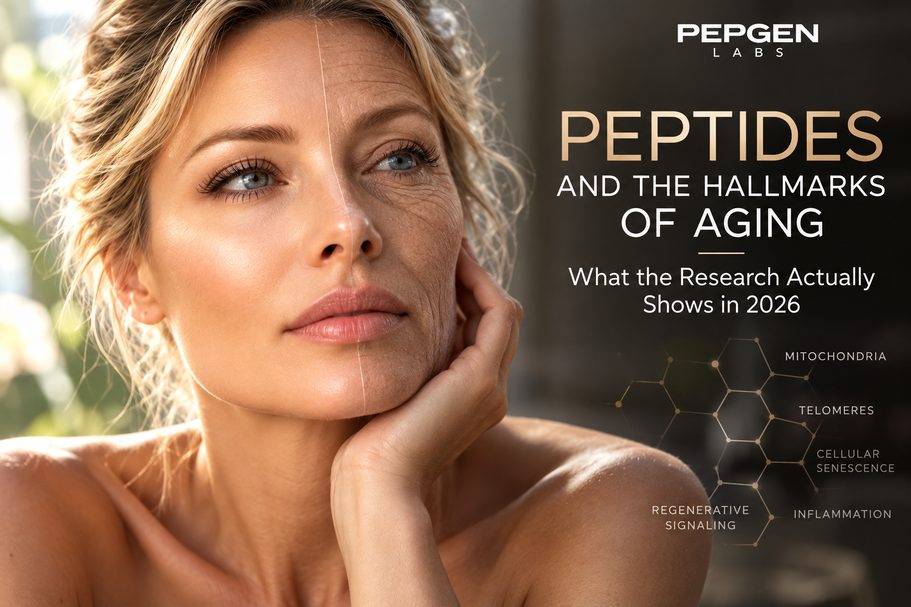
From Mitochondrial Dysfunction and Cellular Senescence to Telomere Biology, Regenerative Signaling and Metabolic Regulation
Aging is often described as though it were one biological process.
It isn’t.
At the cellular level, aging involves interconnected changes affecting DNA stability, telomeres, epigenetic regulation, protein quality control, autophagy, nutrient sensing, mitochondrial function, cellular senescence, stem cells, inflammation and communication between cells.
One of the most influential frameworks for understanding this complexity is the Hallmarks of Aging.
In 2023, Carlos López-Otín and colleagues expanded the framework to 12 Hallmarks of Aging: genomic instability, telomere attrition, epigenetic alterations, loss of proteostasis, disabled macroautophagy, deregulated nutrient sensing, mitochondrial dysfunction, cellular senescence, stem-cell exhaustion, altered intercellular communication, chronic inflammation and dysbiosis. DOI
For peptide research, this raises a much more interesting question than simply asking whether a compound is “anti-aging”:
Where do peptides actually intersect with the molecular biology of aging?
Research into compounds such as MOTS-c, GHK-Cu and Epitalon points toward several very different areas of this biology—from mitochondrial signaling and cellular metabolism to tissue remodeling and telomere research.
They are not interchangeable, and none has been shown to simply reverse human aging.
But together, they illustrate how modern peptide research is beginning to intersect with several of the biological systems scientists use to investigate aging itself.
What Are the 12 Hallmarks of Aging?
The Hallmarks of Aging framework does not describe 12 separate diseases.
Instead, it organizes biological processes associated with aging that interact with one another.
The updated framework identifies:
1. Genomic instability — accumulation of damage and alterations affecting DNA integrity.
2. Telomere attrition — progressive changes involving the protective structures at chromosome ends.
3. Epigenetic alterations — age-associated changes affecting regulation of gene activity without changing the underlying DNA sequence.
4. Loss of proteostasis — declining ability to maintain correctly folded and functional proteins.
5. Disabled macroautophagy — impairment of cellular systems responsible for removing and recycling damaged components.
6. Deregulated nutrient sensing — changes in pathways that detect and respond to energy and nutrient availability.
7. Mitochondrial dysfunction — age-associated changes in mitochondrial energy production, signaling and stress responses.
8. Cellular senescence — accumulation of cells that have entered persistent cell-cycle arrest while potentially continuing to release biologically active signals.
9. Stem-cell exhaustion — declining regenerative capacity of tissue-specific stem-cell populations.
10. Altered intercellular communication — changes in the signaling systems cells use to coordinate biological activity.
11. Chronic inflammation — persistent inflammatory signaling associated with aging.
12. Dysbiosis — age-associated changes in microbial ecosystems and their relationship with the host. DOI
The most important concept is that these hallmarks are interconnected.
Mitochondrial dysfunction can influence inflammatory signaling. Nutrient sensing interacts with autophagy. Senescent cells can change intercellular communication. Epigenetic changes can alter the expression of thousands of genes.
Aging biology is a network, not a single molecular switch.
That distinction is important when examining peptide research.
Where Do Peptides Fit Into the Biology of Aging?
There is no scientifically established peptide that simply reverses all 12 Hallmarks of Aging.
Different research compounds instead intersect with different parts of the aging network.
Three particularly interesting examples are:
MOTS-c → mitochondrial function, metabolic stress and cellular communication
GHK-Cu → extracellular-matrix remodeling, regenerative signaling and inflammatory pathways
Epitalon → telomerase and telomere biology
Their mechanisms are fundamentally different.
And that is exactly why studying them together is useful.
MOTS-c: When Mitochondria Become Signaling Organelles
One of the strongest intersections between peptide research and the Hallmarks of Aging involves mitochondrial dysfunction.
MOTS-c is a 16-amino-acid mitochondrial-derived peptide encoded within the mitochondrial 12S rRNA region.
That makes MOTS-c unusual.
Instead of being encoded by nuclear DNA like many conventional signaling peptides, its genetic origin lies within the mitochondrial genome.
The original discovery research reported that MOTS-c influences metabolic homeostasis and activates AMPK-associated signaling. Subsequent research has expanded the picture considerably. PubMed
Under cellular stress, MOTS-c has been reported to translocate into the nucleus, where it can participate in regulation of genes associated with stress adaptation. Research reviews particularly connect MOTS-c with the folate–AICAR–AMPK pathway, energy metabolism, inflammatory responses and cellular stress homeostasis. PubMed
That places MOTS-c research at the intersection of several aging-related systems:
Mitochondrial dysfunction
Deregulated nutrient sensing
Altered intercellular communication
Cellular stress responses
Inflammatory signaling
Rather than viewing mitochondria only as ATP-producing structures, MOTS-c research supports a broader model in which mitochondria can also act as signaling organelles.
MOTS-c Research at PepGen Lab
For laboratories investigating mitochondrial-derived peptide signaling, MOTS-c connects this aging article directly with PepGen Lab’s mitochondrial research catalog.
Explore PepGen Lab MOTS-c 50 mg Capsules — 60 Capsules →
The PepGen Lab formulation contains 50 mg MOTS-c per capsule, 60 capsules per bottle, and is classified by PepGen as an analytical research material. PepGen Lab
The scientific relevance here is not a claim that MOTS-c reverses aging.
It is the ability to investigate a remarkable biological concept:
Mitochondrial genome → mitochondrial-derived peptide → cellular metabolic signaling → nuclear stress response
That architecture makes MOTS-c one of the most interesting peptide research subjects at the intersection of mitochondria, metabolism and aging biology.
For the deeper mitochondrial story, this section should also link internally to our previous PepGen Lab article:
Mitochondria as a Peptide Target: From MOTS-c Research to the First FDA-Approved Mitochondrial Cardiolipin Binder
From Mitochondria to the Nucleus
MOTS-c also illustrates a concept called mitochondrial retrograde signaling.
The traditional picture of cellular genetics emphasizes instructions moving outward from nuclear DNA.
Mitochondrial biology demonstrates that information can also travel in the other direction.
Under stress conditions, MOTS-c has been reported to relocate to the nucleus and regulate genes containing antioxidant response elements associated with cellular stress adaptation. PubMed
Conceptually:
Mitochondrial state → peptide signal → nuclear response → cellular adaptation
This does not demonstrate that MOTS-c extends human lifespan.
But it helps explain why mitochondrial-derived peptides have become increasingly relevant to aging research.
Reviews of mitochondrial-derived peptides have also discussed their relationship with cellular senescence, chronic inflammation and other age-associated biological processes. PubMed
GHK-Cu: Aging Research Beyond the Mitochondria
Not every peptide associated with aging research acts through mitochondrial pathways.
GHK-Cu provides a completely different example.
GHK—glycyl-L-histidyl-L-lysine—is a naturally occurring tripeptide with a strong affinity for copper, forming the complex GHK-Cu.
Research has investigated GHK and GHK-Cu in relation to tissue remodeling, extracellular-matrix biology, inflammatory signaling, wound repair and regenerative processes.
A peer-reviewed review reports that GHK occurs naturally in human serum and that measured circulating concentrations decline with age. The authors also summarize experimental evidence involving tissue remodeling, wound healing, antioxidant activity and inflammatory pathways. PubMed Central (PMC)
That gives GHK-Cu a very different place within aging research than MOTS-c.
MOTS-c → mitochondrial/metabolic signaling
GHK-Cu → extracellular-matrix and regenerative signaling
GHK-Cu, Collagen and the Aging Extracellular Matrix
Aging does not occur only inside cells.
Cells exist within an extracellular matrix composed of collagen, elastin, glycosaminoglycans and other structural and signaling components.
Changes in this environment influence tissue architecture and cellular behavior.
GHK-Cu has consequently been investigated in experimental systems involving:
fibroblast activity
collagen-related pathways
elastin and extracellular-matrix remodeling
wound-repair signaling
oxidative stress
inflammatory signaling
The literature includes both preclinical research and some skin-related clinical investigation, although evidence varies substantially according to the endpoint being studied. PubMed Central (PMC)
This is much more scientifically meaningful than simply labeling GHK-Cu an “anti-aging peptide.”
The real research question is:
How can a copper-binding tripeptide influence the signaling systems responsible for tissue maintenance, repair and extracellular-matrix remodeling?
GHK-Cu Research at PepGen Lab
This biological connection makes GHK-Cu directly relevant to the PepGen Lab research catalog.
Explore PepGen Lab GHK-Cu 2 mg Capsules — 60 Capsules →
PepGen Lab’s current research formulation contains 2 mg GHK-Cu per capsule with 60 capsules per bottle and is presented specifically around dermal architecture and regenerative-signaling research. PepGen Lab
Importantly, this is not the same research pathway as MOTS-c.
MOTS-c takes us toward mitochondrial signaling and cellular energy regulation.
GHK-Cu takes us toward tissue architecture, extracellular-matrix signaling and regenerative biology.
That difference is exactly what makes the Hallmarks of Aging framework useful: aging cannot be reduced to one pathway.
Our upcoming dedicated article will examine this compound in greater depth:
GHK-Cu: From Copper-Binding Tripeptide to Regenerative Signaling Research
Epitalon and One of Aging Research’s Most Famous Targets: Telomeres
Few areas of aging biology receive as much attention as telomeres.
Telomeres are specialized DNA-protein structures located at chromosome ends.
They contribute to chromosome stability, while telomere dynamics change during cellular division and aging.
For this reason, telomere attrition is one of the recognized Hallmarks of Aging. DOI
This is where Epitalon, also known as AEDG, becomes scientifically interesting.
Epitalon is a short tetrapeptide composed of:
Ala-Glu-Asp-Gly
Its research history includes investigation of telomerase activity and telomere biology.
And this is an area where the evidence needs to be described very carefully.
Does Epitalon Extend Telomeres?
A 2025 study investigated Epitalon in cultured human cell lines and reported increased telomere length associated with telomerase upregulation or alternative lengthening of telomeres, depending on the cell model. PubMed
That makes the study scientifically interesting.
But it does not mean that researchers demonstrated reversal of human aging.
There is a major difference between:
cultured human cells
and
a living human organism.
Cell-culture experiments can identify molecular mechanisms under controlled conditions.
They cannot independently demonstrate that the same intervention extends human lifespan, improves healthspan, prevents age-related disease or reverses biological aging.
Therefore, the scientifically accurate conclusion is:
Epitalon has experimental evidence involving telomerase and telomere biology.
It is not scientifically accurate to turn that finding into:
“Epitalon has been proven to reverse human aging.”
PepGen Lab’s Educational Hub already includes Epitalon within its technical research material, including telomerase and genomic-stability research contexts. PepGen Lab
I am deliberately not placing a fake product button here because I could not verify a currently indexed live individual PepGen Epitalon product page.
When that product page is live, its direct internal product link belongs right here in this section.
Cellular Senescence: When Cells Stop Dividing but Keep Communicating
Another major Hallmark of Aging is cellular senescence.
Senescent cells enter a persistent state of cell-cycle arrest.
But these cells are not necessarily biologically silent.
They can continue releasing cytokines, growth factors, proteases and other signaling molecules into the surrounding environment—a phenomenon commonly associated with the senescence-associated secretory phenotype, or SASP.
This creates connections between cellular senescence and several other hallmarks:
Chronic inflammation
Altered intercellular communication
Stem-cell function
Tissue remodeling
Mitochondrial dysfunction
This is another reason simplistic “one peptide = anti-aging” explanations fail.
A compound interacting with inflammatory signaling does not automatically become a senolytic.
A compound affecting tissue repair does not automatically reverse cellular senescence.
And an effect observed in cultured cells cannot automatically be converted into a human longevity claim.
Chronic Inflammation and the Aging Signaling Environment
The updated Hallmarks framework recognizes chronic inflammation as a distinct hallmark.
Age-associated persistent inflammatory signaling is often discussed under the broader concept of “inflammaging.”
Mitochondrial stress, senescent cells, immune changes and tissue damage can all interact with inflammatory networks.
This creates another point where MOTS-c and GHK-Cu research approach aging biology from different directions.
MOTS-c literature includes research involving metabolic stress, AMPK-related signaling and inflammatory responses. PubMed
GHK/GHK-Cu research includes experimental evidence involving anti-inflammatory signaling, oxidative stress and tissue remodeling. PubMed Central (PMC)
Again:
Different mechanisms.
Different evidence.
Different research questions.
Nutrient Sensing: Where Metabolic Research Meets Aging
One of the most important bridges between metabolic research and aging biology is deregulated nutrient sensing.
Cells constantly monitor nutrient and energy availability.
Networks involving AMPK, mTOR, insulin-related signaling and other metabolic regulators help determine how cells respond.
This creates a direct conceptual connection with our previous PepGen Lab article:
From Single Targets to Triple Agonists: The New Architecture of Metabolic Research
That article examined the evolution from individual metabolic receptor targets toward coordinated signaling architectures.
Aging research approaches the same metabolic network from another direction:
How do changes in energy sensing and metabolic regulation influence cellular resilience over time?
MOTS-c is particularly relevant because its research repeatedly intersects with AMPK-associated energy sensing. PubMed
This is exactly why our PepGen blog should function as an interconnected research library rather than a collection of unrelated posts.
Mitochondrial Dysfunction: The Bridge Between Metabolism and Aging
Among the Hallmarks of Aging, mitochondrial dysfunction creates one of the clearest bridges between metabolic science and aging research.
Mitochondria participate in far more than ATP generation.
They influence:
oxidative metabolism
metabolic signaling
cellular stress responses
redox biology
cell-death pathways
communication with the nucleus
Mitochondrial-derived peptides add another layer to this biology.
Research reviews have discussed MOTS-c and other mitochondrial-derived peptides in relation to cellular senescence, chronic inflammation and age-associated biological changes. PubMed
Experimental work in aged human placenta-derived mesenchymal stem cells has also reported MOTS-c-associated changes involving AMPK, mTORC1 and mitochondrial homeostasis—but importantly, that was an in-vitro cellular study, not evidence of human rejuvenation. PubMed
That distinction matters.
Three Peptides, Three Different Windows Into Aging Biology
The most useful way to understand this field is not to throw everything into a category called “longevity peptides.”
Instead, examine the molecular research question represented by each compound.
MOTS-c — Mitochondrial Signaling
MOTS-c research intersects with:
mitochondrial dysfunction
metabolic stress
AMPK-associated signaling
mitochondrial-to-nuclear communication
energy homeostasis
Explore PepGen Lab MOTS-c Research Compound →
GHK-Cu — Regenerative and Matrix Signaling
GHK-Cu research intersects with:
extracellular-matrix remodeling
fibroblast biology
collagen-related pathways
tissue repair
oxidative and inflammatory signaling
Explore PepGen Lab GHK-Cu Research Compound →
Epitalon — Telomere Biology
Epitalon research intersects experimentally with:
telomerase
hTERT
telomere dynamics
cellular aging models
The 2025 human-cell-line study provides interesting mechanistic evidence, but not proof of human longevity or age reversal. PubMed
These compounds therefore represent different windows into aging biology—not interchangeable effects.
Why “Anti-Aging Peptide” Is Too Simple
The phrase “anti-aging peptide” may be convenient.
Scientifically, it is usually far too broad.
A compound can influence a pathway associated with aging without demonstrating that it slows aging itself.
There is an enormous difference between:
changing a molecular biomarker
altering a cellular pathway
producing an effect in cultured cells
producing an effect in an animal model
demonstrating a clinically meaningful human effect
improving healthspan
and
extending lifespan
These outcomes cannot be treated as equivalents.
This distinction is particularly important in longevity research because exciting mechanistic findings can spread much faster than controlled human evidence.
PepGen Lab’s research content therefore focuses on the molecular pathways, experimental evidence and research architecture behind the compounds, rather than pretending that preclinical findings are established human outcomes.
The Future of Aging Research May Be About Networks
Perhaps the most important lesson from the Hallmarks of Aging framework is that aging cannot easily be reduced to one receptor, one gene, one peptide or one pathway.
The hallmarks interact.
Mitochondrial dysfunction can influence inflammation.
Nutrient sensing can influence autophagy.
Senescent cells can alter intercellular communication.
Stem-cell exhaustion can affect regenerative capacity.
Epigenetic alterations can modify gene expression across entire biological systems.
This is why future aging research may increasingly focus on network biology.
Instead of asking for a single molecular “off switch” for aging, researchers can investigate how multiple biological systems communicate and influence one another.
Peptides fit naturally into that research landscape because peptide biology is fundamentally about molecular signaling and communication.
From MOTS-c to GHK-Cu to Epitalon: What the Research Actually Shows
In 2026, peptide research intersects with aging biology in several scientifically important—but very different—ways.
MOTS-c provides a window into mitochondrial-derived signaling, metabolic stress and mitochondrial-to-nuclear communication.
GHK-Cu provides a window into extracellular-matrix remodeling, regenerative signaling and tissue biology.
Epitalon provides an experimental window into telomerase and telomere biology.
None establishes that human aging can simply be reversed.
But together they demonstrate something more scientifically meaningful:
Peptide research is beginning to intersect with multiple components of the biological architecture researchers associate with aging.
The frontier is therefore not simply about “living longer.”
It is about understanding the molecular systems that determine how cells maintain structure, communicate, adapt to stress, regulate energy, repair damage—and gradually lose resilience over time.
Explore Related PepGen Lab Research Compounds
MOTS-c — 50 mg/capsule, 60 Capsules →
GHK-Cu — 2 mg/capsule, 60 Capsules →
Both are currently present as live product pages on the PepGen Lab site, although the pages currently display them as sold out. PepGen Lab
Scientific References & Verification
López-Otín C, Blasco MA, Partridge L, Serrano M, Kroemer G. — Hallmarks of Aging: An Expanding Universe.
Cell. 2023;186(2):243–278. This is the updated Hallmarks of Aging framework defining the 12 interconnected hallmarks discussed throughout this article. DOI
View on PubMed →
Wan W, et al. — Mitochondria-derived peptide MOTS-c: effects and mechanisms related to stress, metabolism and aging.
Journal of Translational Medicine. 2023;21:36. Reviews MOTS-c mitochondrial encoding, nuclear translocation, AMPK-related signaling, metabolism, stress homeostasis and aging-related research. PubMed
View on PubMed →
Lee C, et al. — The mitochondrial-derived peptide MOTS-c promotes metabolic homeostasis and reduces obesity and insulin resistance.
Cell Metabolism. 2015. Foundational MOTS-c research describing the mitochondrial 12S rRNA-encoded peptide and its relationship with AMPK and metabolic homeostasis in experimental models. PubMed
View on PubMed →
Dou Y, et al. — The Potential of GHK as an Anti-Aging Peptide.
Aging Pathobiology and Therapeutics. 2020;2(1):58–61. Reviews GHK/GHK-Cu research involving tissue remodeling, inflammatory signaling, wound healing and regenerative biology. PubMed Central (PMC)
View on PubMed →
Al-Dulaimi S, et al. — Epitalon increases telomere length in human cell lines through telomerase upregulation or ALT activity.
Aging Cell research / 2025 publication record. Experimental work in cultured human cell lines examining telomere length, telomerase and alternative telomere-lengthening mechanisms. PubMed
View on PubMed →
Page Disclaimer
The information provided in this section is intended strictly for informational and research purposes only. Our articles discuss published studies, emerging scientific developments, and general laboratory topics related to research compounds. References to approved or investigational medicines are included solely to discuss developments in peptide science and drug-delivery research and do not imply that PepGen Lab products are equivalent to, approved as, or intended to be used as those medicines. PepGen Lab research compounds are intended strictly for laboratory research and in-vitro testing. Not for human or animal consumption.
Author: PepGen Lab Research Team